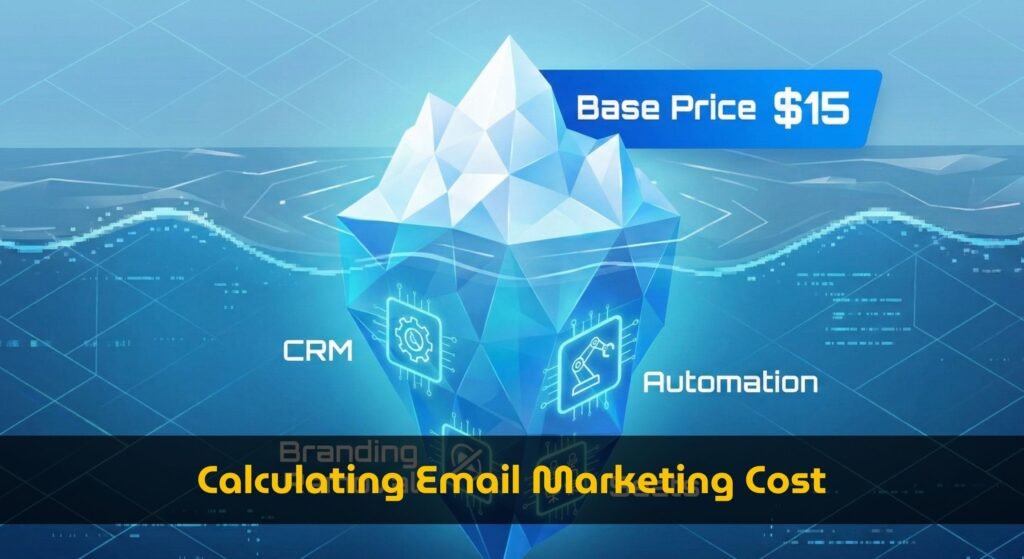

When selecting a marketing stack, most businesses suffer from “Short-Termism.” We look at the pricing page, find the column that matches our current size (e.g., 1,000 subscribers), and make a decision based on that single number.
In 2026, however, the initial price of your email marketing tools cost is virtually irrelevant. The true cost of ownership is determined not by where you start, but by the slope of the inflation curve as you grow.
A tool that costs $15 today might cost $145 in 12 months, and $500 in 36 months—even if your revenue doesn’t grow at the same pace. This phenomenon is known as “SaaS Inflation,” driven by aggressive tier structures and compound growth metrics.
This comprehensive analysis uses the forecasting algorithms from our Email Marketing Cost Calculator to project the 3-Year Total Cost of Ownership (TCO). We will move beyond the sticker price to understand the mathematics of scaling, helping you choose a partner that supports your long-term profitability.
The Mathematics of SaaS Inflation
To forecast your budget accurately, you must understand that email marketing costs do not scale linearly (1:1). They scale exponentially due to “Tier Thresholds.”
Most providers utilize a step-function pricing model. As your list grows, you don’t just pay for more data; you often trigger higher “Per-Unit” costs. Our calculator simulates this using a Compound Monthly Growth Rate (CMGR) formula.
Future_Subscribers = Current_Subs * (1 + Monthly_Growth_Rate)^Month_Number
If (Future_Subscribers > Tier_Limit) {
Trigger Price Jump;
}
This formula reveals the “Hidden Inflation.” A modest 5% monthly growth rate doubles your list size every 14 months. This means you will cross multiple pricing thresholds faster than you anticipate.
Scenario Analysis: The 3-Year Forecast
Let’s run a simulation using real data from our 2026 database. We will compare two popular tools: ActiveCampaign (representing complex CRM suites) and Kit (representing streamlined creator tools).
The Setup
- Starting Point: 2,500 Subscribers
- Growth Rate: 5% Month-over-Month (CMGR)
- Duration: 36 Months
Tier Jump Triggered
Multiple Tier Jumps
Analysis: While the list size grew by roughly 5.6x, the cost grew by 3.5x. However, the crucial observation is the velocity of the cost increase between Month 12 and Month 24.
Comparative Economics: Curve Variance
Not all email marketing tools cost structures behave the same way. The “Slope” of the pricing curve is a critical selection criterion.
According to our data, Kit (ConvertKit) employs a flatter pricing curve for its “Creator” plan.
- ActiveCampaign: At 15,000 subscribers (projected Month 36), the cost hits $265/mo (Plus Plan).
- Kit: At 15,000 subscribers, the cost hits $169/mo (Creator Plan).
The Delta: Over a 3-year period, the cumulative difference (TCO) between these two choices exceeds $2,500. This is capital that could be reinvested into ad spend or content creation.
The “Feature Creep” Variable
Inflation isn’t just about list size. It’s also about “Feature Activation.”
In Year 1, you might only need basic newsletters. By Year 2, you might hire a team member, requiring an additional user seat. By Year 3, you might want to integrate Salesforce.
Our calculator’s “Feature Gates” logic (`opt-seats`, `opt-crm`) allows you to simulate these future needs.
Example: If you project needing 3 team seats in Year 2, GetResponse forces an upgrade from the “Email Marketing” tier to the “Marketing Automation” tier. This single operational change can instantaneously increase your monthly burn rate by 40%, independent of subscriber growth.
Strategic Budget Management: The Portfolio Approach
Smart organizations view their marketing stack as an investment portfolio. Efficiency in one area allows for aggression in another.
If you can optimize your email spend by selecting a tool with a flatter inflation curve, you free up budget for acquisition channels, such as SEO.
Balance Your Total Marketing Stack
Don’t just forecast email costs. Apply the same rigorous 3-year TCO analysis to your SEO software. Are you paying for Ahrefs credits you won’t use until Year 3? Audit your search tools to ensure holistic budget efficiency.
Actionable Steps: Running Your Forecast
To avoid “Billing Shock” in 2027 or 2028, we recommend running a TCO simulation before signing any annual contract.
Step 1: Estimate Your Growth Rate
Look at your last 6 months of subscriber growth. Is it 2%? 5%? 10%? Be realistic.
Step 2: Configure the Calculator
- Open the 3-Year Cost Predictor.
- Set your Current Subscribers.
- Set the “MoM Growth” slider to your estimated rate.
- Crucial Step: Look at the line graph at the bottom. Identify the exact month where the lines cross or spike.
Step 3: Analyze the “Cross-Over Point”
You may find that Tool A is cheaper for the first 11 months, but Tool B becomes significantly cheaper from Month 12 to Month 36. If you plan to stay in business long-term, Tool B is the rational financial choice, even if the Day 1 price is higher.
Conclusion: Long-Term Vision Wins
The sticker price is a vanity metric. The email marketing tools cost that matters is the 3-Year Total Cost of Ownership.
By forecasting your growth and understanding the inflation mechanics of SaaS pricing tiers, you can make an investment decision today that your CFO (and your future self) will thank you for. Don’t buy for where you are; buy for where you are going.
See Your Future Bill
Use our algorithmic forecaster to see exactly how much your email list will cost in 3 years.
Launch 3-Year Forecast