
Email Marketing Sends vs Contacts Pricing: Essential 2026

Short answer: Email marketing sends vs contacts pricing is a choice between paying mainly for message volume and paying mainly for the number of stored or marketable people. Send-based billing generally fits smaller lists with selective campaigns; contact-based billing can fit frequently mailed, highly engaged lists. The lower total cost depends on each vendor’s counting rules, allowances, overages, add-ons, and your expected growth.
Email marketing broadly means sending commercial messages through email, including communications intended to build customer relationships or encourage purchases. (Wikipedia) Comparing plans therefore requires more than checking a headline subscription price: you must model how the platform meters the activity behind those messages.
Table of Contents
- Key Takeaways
- Understand the Billing Units
- Send-Based Billing
- Contact-Based Billing
- Decision Table
- Total-Cost Model
- Methodology and Assumptions
- Compliance Costs
- Checklist
- Limitations
- Frequently Asked Questions
- Conclusion
Key Takeaways
The best billing basis is the one that remains economical under realistic list growth, campaign frequency, and overage scenarios—not merely today’s usage.
- Email marketing sends vs contacts pricing compares metered message volume with metered audience size.
- A large database does not automatically favor contact billing; inactive records may still consume a contact allowance.
- Frequent campaigns do not automatically favor send billing; repeated messages can quickly consume a volume allowance.
- Compare total cost, including overages, add-ons, implementation work, list hygiene, and internal administration.
- Obtain written definitions for billable contacts, duplicate records, suppressed addresses, transactional messages, and billing-period resets.
How Email Marketing Sends vs Contacts Pricing Works
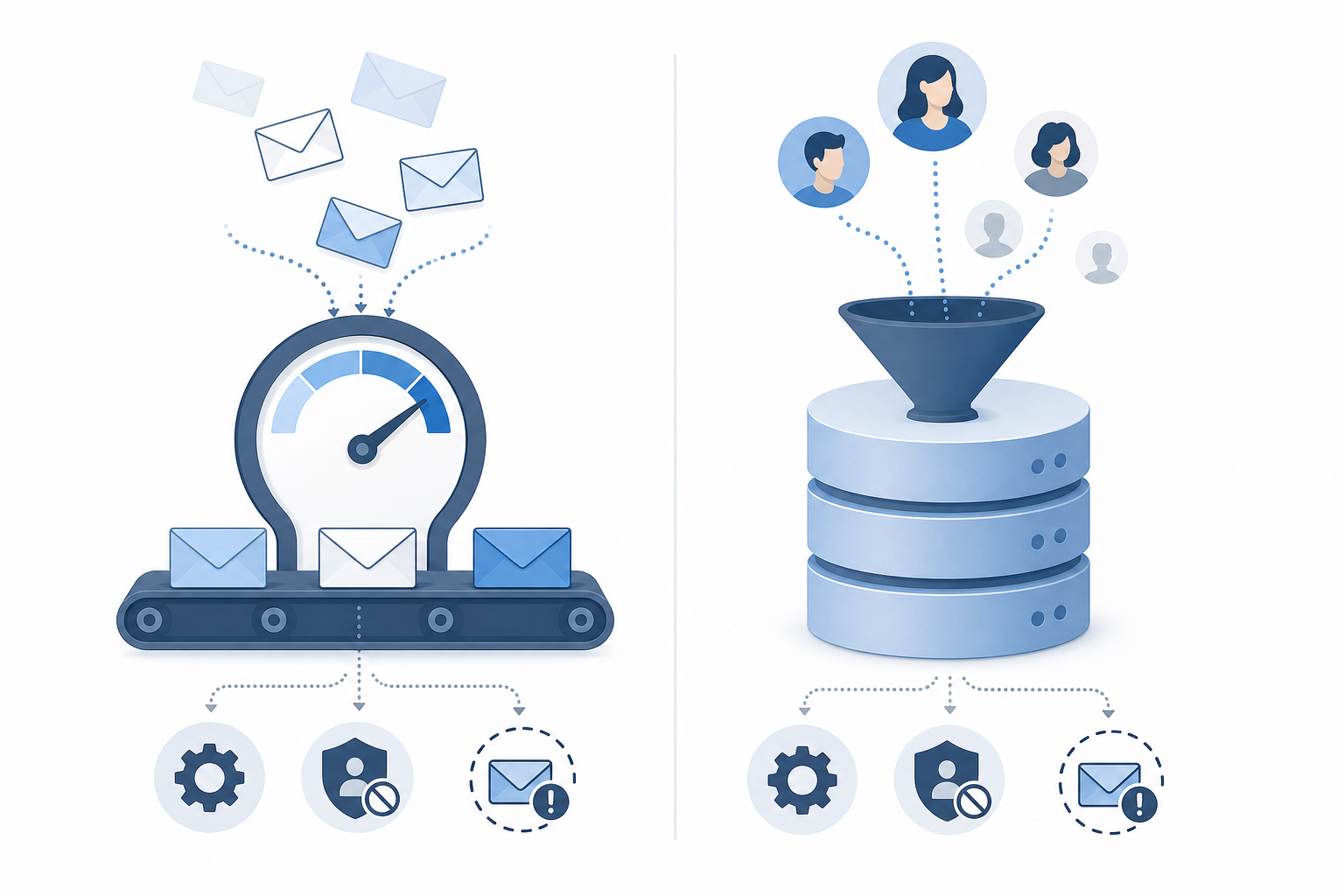
Email marketing sends vs contacts pricing uses different units for the subscription meter. A send-based plan primarily measures messages processed during a billing period. A contact-based plan primarily measures records, subscribers, or marketable profiles, although it may also impose a sending allowance.
A billable send is a message counted against the plan’s volume. Vendors may treat attempted, accepted, delivered, automated, test, or transactional messages differently, so the contract’s definition matters.
A billable contact is a person or record counted toward the plan’s audience tier. It may differ from a unique email address, an active subscriber, or a recipient who can legally receive marketing. Duplicate, unsubscribed, bounced, archived, and suppressed records require explicit treatment in the quote.
Price is the amount shown for a subscription or usage tier. Total cost is broader: subscription price plus overages, paid features, data storage, implementation, migration, compliance work, and ongoing administration. This distinction prevents a low entry price from becoming the only decision criterion.
When Send-Based Pricing Is a Better Fit
Send-based billing is usually the stronger candidate when the addressable database is large but only selected segments receive campaigns. The relevant question is whether predictable message volume costs less than carrying every eligible record in a contact tier.
Potential fits include seasonal communication, event announcements, regional segmentation, infrequent newsletters, or databases containing many valid but rarely contacted customers. The model can also be easier to forecast when campaign schedules and automation volumes are stable.
Its main risk is volume variability. A new nurture sequence, resend, transactional workflow, or additional campaign can raise usage even if the database does not grow. Ask whether failed deliveries, tests, internal seeds, and automated messages consume the allowance.
Model a normal period and a high-activity period. If the high-activity result creates substantial overage or forces a larger tier, email marketing sends vs contacts pricing may favor contact billing despite a lower initial send-based quote.
When Contact-Based Pricing Is a Better Fit
Contact-based billing is generally the stronger candidate when a compact, engaged audience receives frequent newsletters, automations, and lifecycle messages. The economic advantage depends on whether the included send allowance supports that frequency without separate usage charges.
This approach can make campaign planning less sensitive to each additional broadcast. However, database growth, duplicates, inactive subscribers, and retained suppression records may move the account into a higher tier even when campaign volume remains stable.
Clarify whether the vendor counts all stored profiles or only subscribed and marketable contacts. Also ask how multiple lists, workspaces, channels, archived records, and restored contacts affect the meter. A contact total exported from another system may not match the vendor’s billable total.
For email marketing sends vs contacts pricing, contact billing becomes less attractive when list growth outpaces engagement or when cleanup policies leave many nonmarketable records in paid storage.
Decision Table: Choose the Better Billing Basis
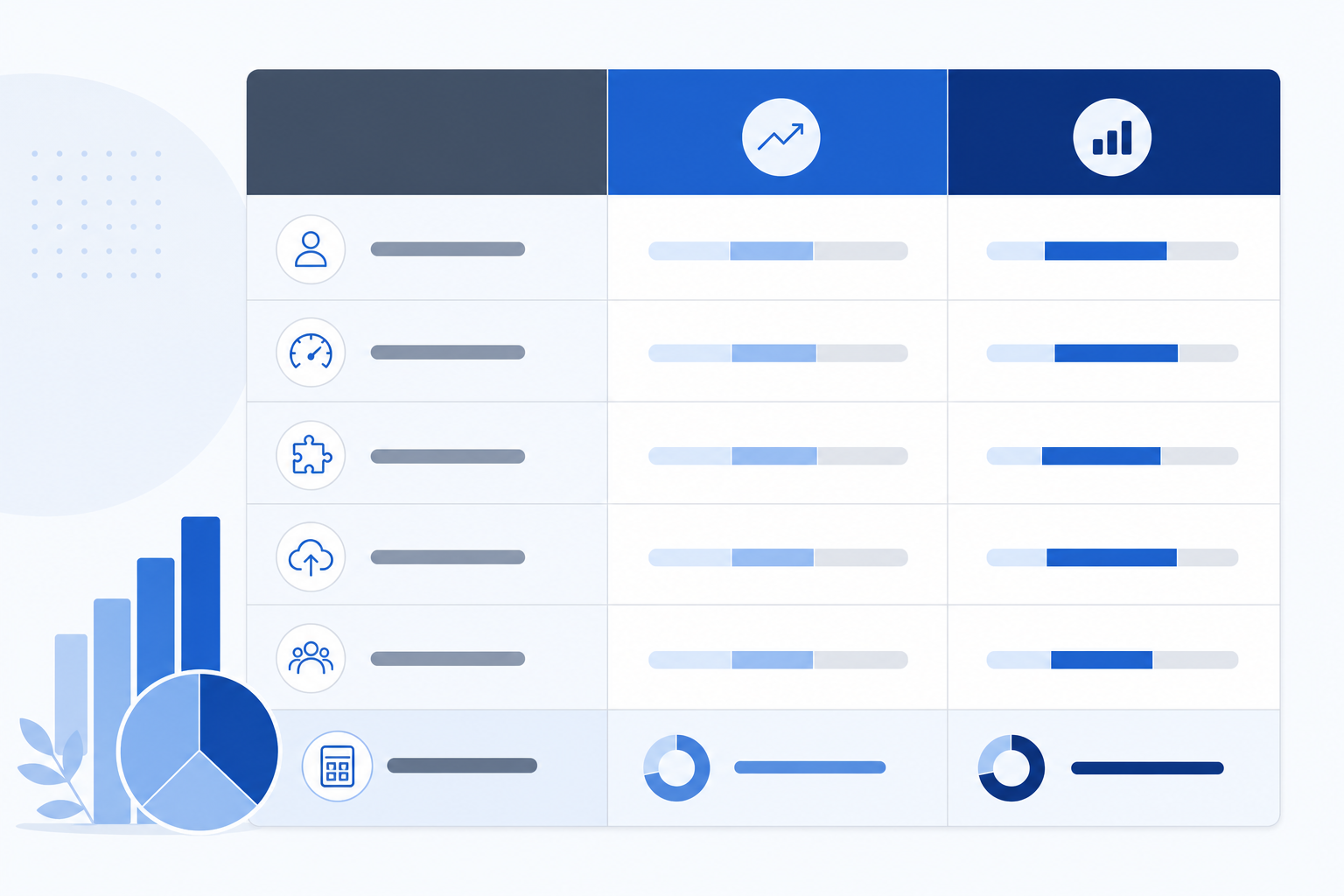
Use email marketing sends vs contacts pricing as a scenario decision rather than a universal rule. The table identifies the billing basis to investigate first; it does not replace a vendor-specific quote or contract review.
| Operating pattern | Investigate first | Why | Verify before choosing |
|---|---|---|---|
| Large database, narrow campaign segments | Send-based | Payment can track actual messaging rather than every stored record | Minimum commitment, overages, automation sends |
| Small audience, frequent communication | Contact-based | Repeated campaigns may fit within the contact tier’s allowance | Send caps, throttling, fair-use terms |
| Rapid audience growth | Send-based | Contact tiers may rise before campaign volume rises | Storage rules and future volume |
| Highly variable campaign calendar | Contact-based | A sufficient allowance may reduce exposure to send spikes | Included volume and excess-send pricing |
| Many inactive or suppressed records | Send-based or cleanup first | Stored records may inflate a contact meter | Whether suppressed records remain billable |
| Heavy automation or transactional traffic | Quote both | Workflow messages can change the volume calculation | Which message classes count as sends |
The practical decision rule is to eliminate any option that becomes unaffordable under a plausible high-use scenario. Then compare the surviving options on functionality, governance, integration effort, and contractual flexibility.
A plan should also support the required segmentation, consent records, suppression handling, reporting, and data access. A lower metered cost is not useful if essential capabilities require paid add-ons or manual work.
Compare Total Cost, Not Just Plan Price
A reliable email marketing sends vs contacts pricing comparison adds every incremental cost caused by the billing model. Use the same planning period, currency, tax treatment, feature scope, and audience definition for each quote.
Include these components:
- Base subscription or committed usage fee
- Expected send or contact overage
- Required automation, reporting, testing, or collaboration add-ons
- Dedicated infrastructure or deliverability services, if required
- Migration, integration, template, and data-cleaning work
- Ongoing list governance and usage monitoring
- Contract exit, data export, or parallel-running costs
Do not treat labor as free merely because it is internal. A cheaper send plan may require frequent volume monitoring; a cheaper contact plan may require regular archiving, deduplication, and suppression audits. Estimate the hours and apply an internal planning rate.
Use the TrueSaaSCost email marketing cost calculator to compare email marketing sends vs contacts pricing with consistent assumptions. Enter vendor quotes rather than treating calculator outputs as published market prices.
Methodology and Assumptions
The email marketing sends vs contacts pricing framework compares normalized total cost across expected, low-use, and high-use scenarios. It uses quoted prices and user-supplied assumptions; it does not infer current vendor rates or claim that one billing model is always cheaper.
Define these variables:
- C: vendor-defined billable contacts during the period
- S: vendor-defined billable sends during the period
- Q: quoted base subscription or commitment
- O: estimated overage charge
- A: required add-on cost
- M: migration and implementation cost allocated to the period
- L: estimated internal labor cost
Use this reproducible formula:
Estimated total cost = Q + O + A + M + L
For contact scenarios, project C after deduplication, suppression handling, expected acquisition, and expected removals. For send scenarios, project S from broadcasts, automated journeys, transactional messages, tests, and planned resends according to the vendor’s counting rules.
Example: Synthetic Comparison
This example is illustrative and is not market data or a representation of any vendor’s pricing.
Assume a contact-based quote of $480 per planning period, with $120 of estimated list-management labor. Its modeled total is $600.
Assume a send-based quote of $350 covering 50,000 billable sends. Project 54,000 sends, an estimated overage of $0.01 for each excess send, and $180 of monitoring labor. Overage is 4,000 × $0.01 = $40, producing an estimated total of $570.
Under those assumptions, the send-based option is $30 lower. The conclusion changes if projected volume, overage terms, labor, or the contact definition changes. Replacing every assumed value with a written quote makes the example reproducible for a real purchase.
The example shows why email marketing sends vs contacts pricing should be stress-tested rather than decided from the base fee alone. Record each input’s source, owner, date, and confidence level so reviewers can challenge assumptions without rebuilding the model.
Include Compliance and List Governance
Compliance does not determine the cheaper meter, but it contributes to operating cost under either email marketing sends vs contacts pricing model. Budget for consent records where applicable, sender identification, suppression handling, unsubscribe processing, and policy review.
The United States Federal Trade Commission states that the CAN-SPAM Act covers commercial email, applies beyond bulk email, and does not provide a business-to-business exception. (FTC CAN-SPAM compliance guide) The guide requires accurate routing information, nondeceptive subject lines, advertisement identification, a valid physical postal address, and a clear opt-out mechanism. (FTC)
Those requirements are sourced facts, but this article is not legal advice. Regional privacy and electronic-marketing rules can differ. Confirm obligations with qualified counsel for the sender’s locations, recipients, message types, and data practices.
Practical Plan Comparison Checklist
Use this checklist before approving email marketing sends vs contacts pricing or signing a renewal:
- Export active, inactive, unsubscribed, bounced, duplicate, and suppressed records separately.
- Map every broadcast, automation, resend, test, and transactional workflow.
- Request written definitions of a billable contact and a billable send.
- Confirm included volume, tier boundaries, overages, minimums, and reset rules.
- Identify features that require a higher package or separate add-on.
- Model expected, low-use, and high-use scenarios with identical assumptions.
- Add migration, implementation, integration, governance, and monitoring labor.
- Check contract length, renewal mechanics, data export, and deletion procedures.
- Validate compliance workflows and responsibility for opt-out processing.
- Ask the vendor to confirm the modeled scenario in writing.
You can also review the broader TrueSaaSCost website when comparing software costs that interact with email operations, such as customer data, analytics, and workflow tools.
Limitations
Any email marketing sends vs contacts pricing result is conditional on the inputs and vendor definitions. Uncertainty includes future list growth, campaign frequency, automation behavior, deliverability-related retries, feature changes, taxes, exchange rates, negotiated discounts, and internal labor.
This article does not contain a current vendor price database because no approved vendor pricing sources were supplied. It also cannot resolve regional legal requirements or account-specific contract language. Verify a written quote when usage is close to a tier boundary, when multiple message types are involved, or when a contract bundles channels and services.
Sources last verified: 2026-07-19.
Frequently Asked Questions
The following answers address the billing questions most likely to change a commercial decision.
Is send-based pricing cheaper than contact-based pricing?
Not inherently. Send-based pricing can be cheaper for a large list receiving relatively few messages, while contact-based pricing can be cheaper for a smaller list contacted frequently. Calculate total cost using the vendor’s definitions, included allowances, overages, add-ons, and your high-use scenario.
Do unsubscribed contacts count toward a contact limit?
They may, depending on the vendor’s contract and data model. Do not assume that unsubscribed, bounced, archived, or suppressed records are excluded. Request a written explanation and reconcile it with an account export before accepting a quote.
What should count as a send in the forecast?
Include every message type the vendor treats as billable. Possible categories to verify include broadcasts, automations, transactional email, tests, internal seeds, retries, and resends. The forecast should follow contract definitions rather than a generic definition of delivered email.
How often should I compare email marketing sends vs contacts pricing?
Compare it during initial selection, before renewal, and whenever audience size, campaign cadence, automation scope, or transactional volume changes materially. Recalculate with current exports and quotes instead of carrying forward assumptions that may no longer describe operations.
Can list cleanup reduce email platform cost?
It can reduce modeled cost when the vendor bills records that cleanup legitimately removes or archives. Cleanup must preserve required suppression and compliance information. Confirm how deleted, archived, merged, and suppressed records affect billing before changing retention practices solely to lower cost.
Conclusion
Email marketing sends vs contacts pricing is best decided by modeling billable audience size, message volume, overages, add-ons, implementation, and labor under more than one operating scenario. Send billing often deserves attention for selective communication to a large database; contact billing often deserves attention for frequent communication to a compact, engaged audience. Vendor definitions can reverse either conclusion.
For a clear next step, gather written quotes and usage exports, then run them through the email marketing cost calculator. Save the assumptions with the result and ask each shortlisted vendor to confirm how its contract would meter the modeled activity.