

This comparison supports the SEO Cost Calculator and the SEO Cost Hub. Use it to pick the execution model before estimating your monthly SEO budget.
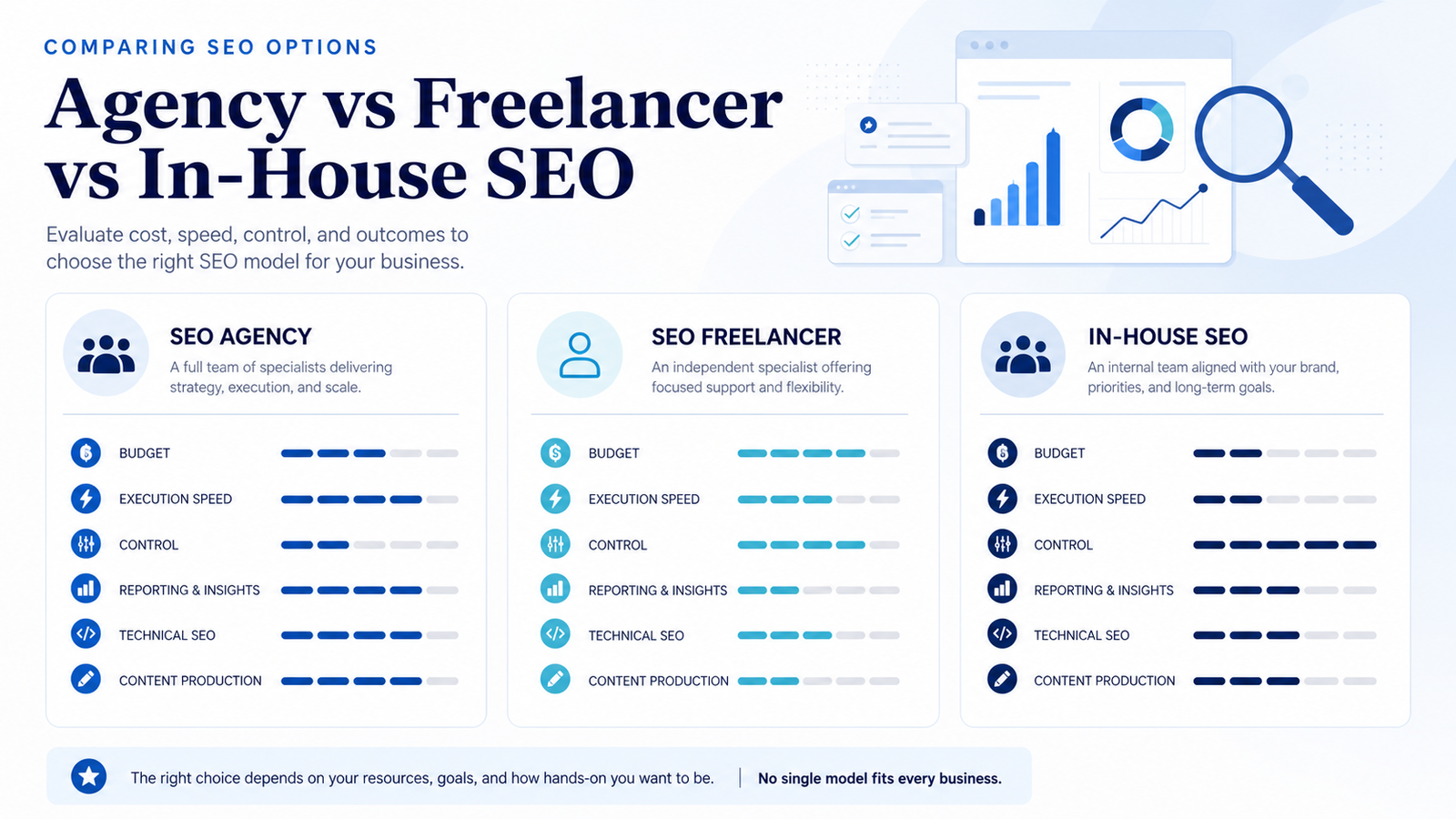
Key Takeaways
Use this SEO agency vs freelancer framework to compare the same scope, ownership boundary, and completed outcomes. Provider labels alone do not reveal total execution cost.
- An agency is usually strongest when several specialties must move together and the buyer lacks internal project capacity.
- A freelancer is usually strongest when the problem is bounded and internal teams can implement recommendations.
- In-house SEO becomes attractive when search affects product, engineering, editorial, and analytics decisions every week.
- A hybrid model often works when one internal owner sets priorities while outside specialists add depth or capacity.
- Compare total monthly execution cost per useful completed outcome, not retainer, hourly rate, or salary alone.
Article scope
Primary keyword: SEO agency vs freelancer
Secondary keywords: SEO agency cost, SEO freelancer cost, in-house SEO cost, SEO execution model, monthly SEO budget.
Search intent: the reader wants to choose how SEO work should be executed before committing budget.
Target calculator: SEO Cost Calculator. Target cluster: SEO Cost Hub.
Why the SEO agency vs freelancer model changes total cost
The delivery model changes which capabilities are included, who coordinates them, and whether recommendations become completed work. SEO is a connected system rather than a single subscription or audit. The buyer must account for diagnosis, prioritization, implementation, content, measurement, and iteration.
Google describes SEO as helping search engines understand content and helping users decide whether to visit a site. Its starter guide covers site organization, descriptive URLs, useful content, links, images, and search appearance, illustrating why SEO crosses editorial and technical ownership. Google Search Central documents that scope in its SEO Starter Guide.
A freelancer may supply excellent analysis but still depend on your developer and editor. An agency may include strategy, specialists, and account management but exclude implementation. An internal hire may own priorities but still need outside help for migration, digital PR, or advanced diagnosis. The label matters less than the delivery boundary.
In an SEO agency vs freelancer comparison, write down who performs each recurring task and who approves it. If a task has no owner, do not treat it as included. That rule prevents a low quote from looking complete when the buyer must quietly supply half of the delivery system.
SEO agency vs freelancer vs in-house comparison table
Use the table as a scope map, not a verdict. A strong specialist can outperform a general agency, and a capable internal owner can make either external model more effective. Score the actual provider and operating setup against the work your site requires.
| Decision factor | SEO agency | SEO freelancer | In-house SEO |
|---|---|---|---|
| Best fit | Broader execution, multiple specialists, faster ramp, recurring campaigns. | Focused projects, technical audits, content strategy, flexible support. | Long-term ownership, deep product knowledge, internal prioritization. |
| Cost structure | Retainer or project fee; may include account management and specialist time. | Hourly, project, or monthly retainer; scope needs tight definition. | Salary, benefits, tools, training, management, hiring time. |
| Technical SEO | Strong if the agency has technical specialists and developer coordination. | Strong if the freelancer specializes in technical SEO; variable otherwise. | Strong when the team has developer access and SEO experience. |
| Content velocity | Can scale if writers, editors, and strategists are included. | Limited by individual bandwidth unless paired with writers. | Depends on internal writers, editors, designers, and publishing process. |
| Control | Shared control; strategy depends on scope and communication quality. | Moderate control; can be highly collaborative with clear briefs. | Highest control over priorities, roadmap, and cross-team execution. |
| Reporting | Often structured, but quality varies by agency. | Varies; may need explicit reporting requirements. | Highest visibility if GSC, GA4, rank tracking, and dashboards are owned internally. |
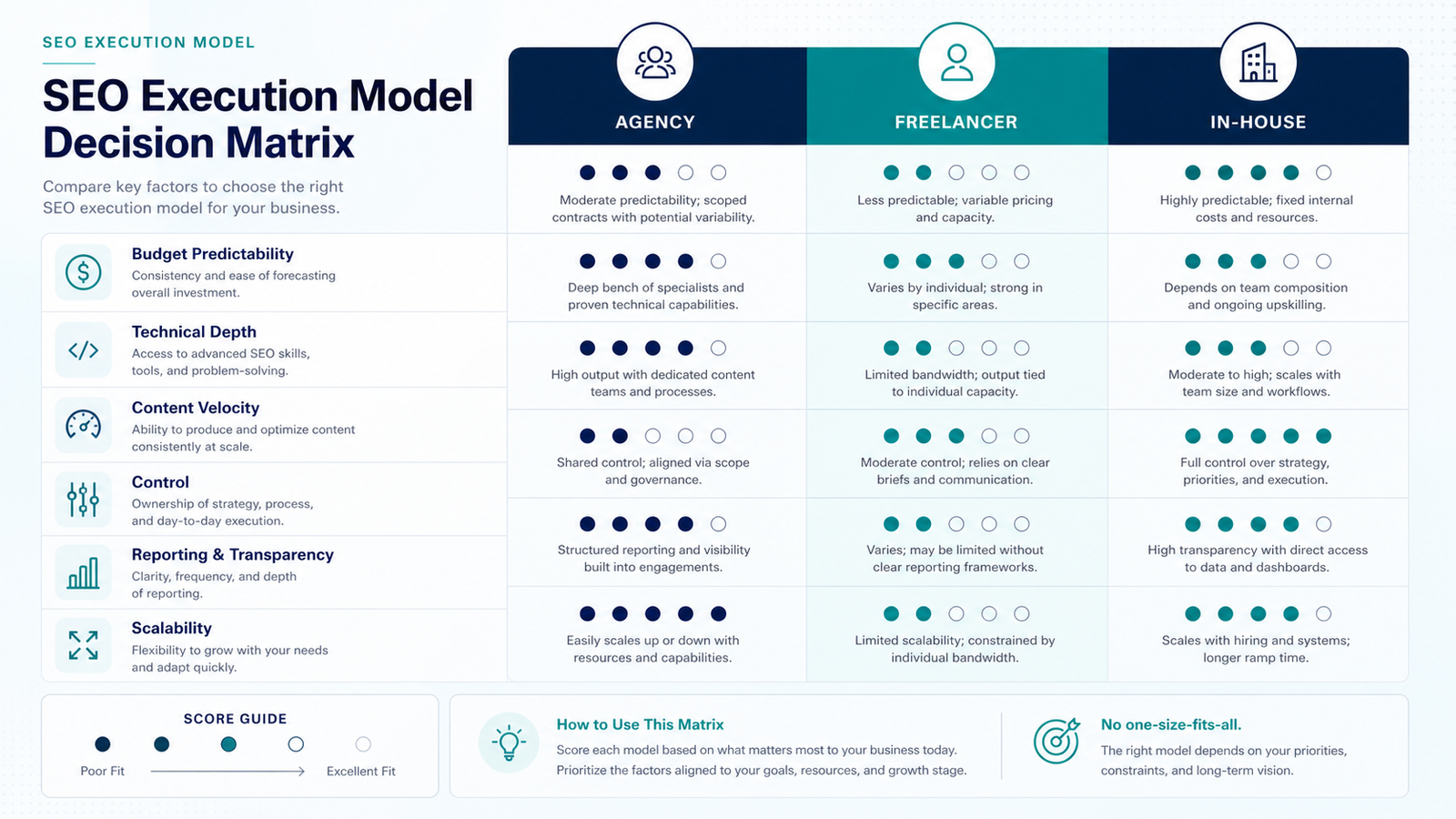
Decision matrix
The best model removes the current bottleneck without creating a more expensive one. Use the matrix as a starting point, then test the actual provider against implementation access, production capacity, reporting, and continuity.
Choose an agency when…
You need many capabilities at once: technical SEO, content strategy, writing, reporting, audits, link analysis, project management, and repeatable delivery. Agencies can be expensive, but they can reduce coordination time if the team is competent.
Choose a freelancer when…
You have a clear problem and need focused expertise: technical audit, content refresh plan, keyword research, internal link map, migration review, or reporting setup. The risk is bandwidth and dependency on one person.
Choose in-house when…
SEO is strategic enough to justify permanent ownership. In-house works best when SEO must influence product, engineering, content, analytics, and marketing decisions every week.
Implementation ownership
Recommendations have limited value without implementation. Ask who creates developer tickets, edits pages, publishes content, validates releases, and follows up on unresolved issues. An external provider with no implementation path may produce a backlog instead of progress. One accountable internal owner reduces that gap even when specialist work remains outsourced.
Coordination load
Agency account management can reduce coordination when it genuinely connects strategists, writers, and technical specialists. It can also add meetings and translation layers. A freelancer usually requires more direct management but may offer faster specialist communication. In-house delivery reduces vendor coordination while increasing hiring, coaching, and cross-functional management.
Content and technical capacity
Separate strategy from production. A provider may include keyword research and briefs but not writing, design, subject-matter review, CMS entry, or post-publication updates. Technical expertise also matters only when it reaches the code, templates, or platform settings that control the issue. SEO includes both technical and content practices; this overview of search engine optimization describes the broader discipline.
Measurement and continuity
Useful reporting connects search visibility, landing-page behavior, completed work, unresolved constraints, and next actions. Require access to the underlying data and a documented method. Reduce freelancer key-person risk, agency team-change risk, and in-house turnover risk with shared accounts, written decisions, reusable briefs, change logs, and a clear handover process.
Hidden costs by model
Every model shifts costs rather than eliminating them. Agency cost can hide in account management, slow approval cycles, unclear deliverables, and reports that do not translate into implementation. Freelancer cost can hide in missed capacity, weak documentation, or additional specialists. In-house cost can hide in recruiting, training, tools, management time, and displaced internal work.
This is why a monthly SEO budget should separate delivery from tools. Use the Monthly SEO Budget Planning Guide to define the budget buckets, then use the calculator to model execution. If you are tempted by very cheap retainers, read the Low-Price SEO Hidden Costs guide before committing.
Methodology and Assumptions
This comparison treats cost as the resources required to complete useful SEO work, not as a market-price survey. It does not claim that one provider category has a universal price or performance level. The framework is a reproducible budgeting method that uses the buyer’s quotes and internal time estimates.
Start with five monthly buckets: external fees, internal labor, software, production, and implementation. Keep one-time setup costs separate so they do not distort recurring run rate. Then define useful output: completed technical fixes, updated or published pages, validated experiments, and reporting decisions. Do not count recommendations as completed output until an owner has implemented and checked them.
Monthly total cost = external fees + internal management time + tools + content production + implementation labor.
Comparable unit cost = monthly total cost / agreed completed outcomes.
Use the same scope and period for each option. These formulas support planning; they do not predict rankings, traffic, or revenue.
For an SEO agency vs freelancer comparison, normalize each proposal before judging it. If one quote includes writing and implementation while another includes strategy only, add the missing work to the second scenario. If the internal team has unused capacity, use its loaded labor cost; if the work displaces a critical product task, record that opportunity cost as a decision constraint.
Example: compare three proposals with the same scope
This worked example demonstrates the method with hypothetical inputs, not market averages. Replace every amount and hour with your own quote, payroll cost, tool stack, and internal capacity before using the result.
Assume a team needs a technical review, four page updates, reporting, and implementation follow-up each month. Proposal A is an agency quote of $4,000 and needs 8 internal management hours valued at $60 per hour. Proposal B is a freelancer quote of $2,400, needs 16 management hours, and requires $1,000 of separate writing and implementation. Proposal C is an internal allocation of $5,500 in loaded labor plus $500 in tools and specialist support.
| Example option | Calculation | Illustrative monthly total | Question to verify |
|---|---|---|---|
| Agency | $4,000 + (8 x $60) | $4,480 | Are writing and implementation included? |
| Freelancer | $2,400 + (16 x $60) + $1,000 | $4,360 | Who covers absence and specialist gaps? |
| In-house allocation | $5,500 + $500 | $6,000 | Does the allocation displace higher-priority work? |
The example does not make the freelancer automatically best. If the agency includes stronger implementation and completes more useful work, its comparable unit cost may be lower. If the in-house owner improves product and editorial decisions beyond the listed deliverables, the table may understate internal value. Record those differences explicitly instead of hiding them inside the provider label.
Checklist before choosing
Do not approve a proposal until scope, ownership, evidence access, and handover are written down. The checklist turns a sales description into an operating agreement that can be compared with alternatives.
For a fair SEO agency vs freelancer review, send both candidates the same workload, required outputs, access constraints, reporting expectations, and implementation boundary.
Workload checklist
- How many pages need technical fixes or refreshes?
- How much content must be produced or updated each month?
- Who owns developer tickets and implementation follow-through?
- What reporting does leadership or clients actually need?
Cost checklist
- Include SEO software and reporting tools.
- Include management and coordination time.
- Include content writing, editing, images, publishing, and QA.
- Include technical implementation, not just audit recommendations.
Model your SEO agency vs freelancer decision
Enter the external fee, internal hours, tools, content, reporting, and technical implementation for each option. Compare complete monthly scenarios instead of isolated quotes.
Limitations
This framework cannot determine provider quality or predict search outcomes. Capability varies within every model, and the same provider may perform differently as scope, team, platform, competition, and approval speed change.
The example is illustrative and excludes taxes, regional labor differences, contract terms, recruitment costs, turnover, incentives, and unusual technical projects. Tool requirements can also change with site size and reporting needs. Verify current quotes, employment costs, service exclusions, data ownership, cancellation terms, and implementation responsibilities before committing budget.
Search guidance and interfaces can change. Sources last verified: 2026-07-19. Review this page when Google materially updates its published documentation or when the TrueSaaSCost calculator changes its cost model.
Frequently Asked Questions
Is an SEO agency more expensive than a freelancer?
Usually the agency invoice is higher because it may include account management and several specialties. That does not prove higher total cost. Compare implementation, internal management hours, content production, tools, and completed outcomes for the same scope and period.
Is in-house SEO cheaper than hiring an agency?
Not necessarily. In-house cost includes loaded labor, recruiting, tools, training, management, and specialist support. It can become efficient when SEO requires frequent coordination with product, engineering, analytics, and editorial teams.
When should a company hire an SEO freelancer?
Hire a freelancer when the objective is specific, an internal owner can make decisions, and implementation resources already exist. Examples include migration review, technical diagnosis, content refresh planning, internal links, or analytics setup.
When should a company use an SEO agency?
Use an agency when several capabilities must operate together and the company needs coordinated recurring delivery. Confirm the named team, included production, implementation boundary, reporting method, communication cadence, and handover terms.
Can a hybrid SEO model be better than all three options?
Yes. A hybrid can combine internal ownership with freelancer specialization or agency production. It works when responsibilities are explicit, systems are shared, and one person remains accountable for priorities and implementation.
Conclusion
The SEO agency vs freelancer choice should follow the work, ownership, and operating constraints. Agencies suit coordinated breadth, freelancers suit defined specialist needs, and in-house SEO suits persistent cross-functional ownership. A hybrid can combine those strengths when one person remains accountable.
Build each scenario with the same scope, include internal time and excluded work, then compare useful completed outcomes. Use the SEO Cost Calculator to make assumptions visible and revise them when quotes or internal capacity change.