
Quick answer: Transactional email pricing usually follows one of four models: metered pay-as-you-go, monthly tiers, bundles with overage charges, or negotiated enterprise contracts. The right choice depends on monthly send volume, traffic volatility, data retention, dedicated IP needs, and support, not the headline price alone. Model a normal month and a peak month, add every required feature, then compare the effective cost per 1,000 delivered messages before committing.
This guide evaluates transactional messages such as password resets, receipts, account alerts, and authentication codes. It does not treat contact-based newsletter software as the same market. That distinction matters because transactional email pricing is normally driven by messages, infrastructure, and delivery operations, whereas marketing platforms often charge by stored contacts, seats, or campaign features. All provider facts and public prices below were checked on July 25, 2026; verify the linked official pages before buying because plans can change.
What are the four transactional email pricing models?
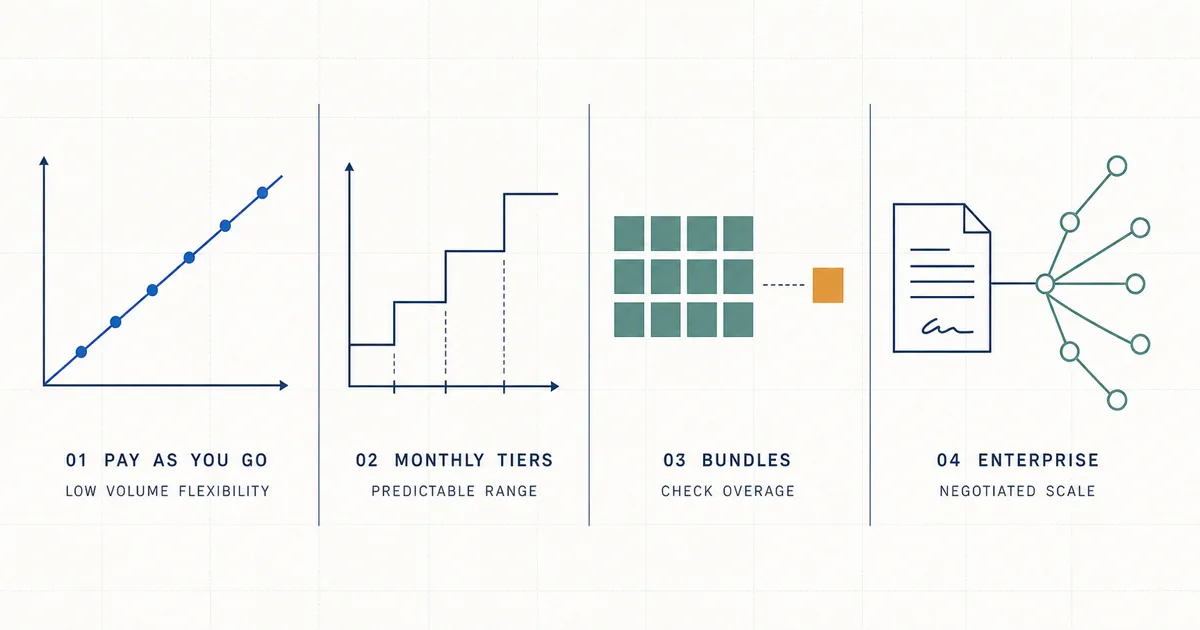
The four common models are metered pay-as-you-go, monthly tiers, bundled allowances with overages, and negotiated enterprise contracts. Each model moves cost and risk to a different place. A useful transactional email pricing comparison therefore starts with the billing unit and the behavior of unused allowance, not a vendor logo.
1. Metered pay-as-you-go
A metered plan charges for the messages or message units actually processed. It reduces the cost of unused capacity and keeps a variable workload easy to model. However, a traffic spike raises the invoice immediately, and optional services may be separate line items. Amazon SES is a clear official example: its pricing page describes the service as pay-as-you-go with no minimum charge and lists outbound email at $0.10 per 1,000 messages, plus possible data and add-on charges. See the Amazon SES pricing page.
2. Monthly tiers
A tier sets a recurring fee for an included volume and feature package. This transactional email pricing model gives finance a predictable base bill, but moving one message above a boundary may trigger overage or a plan change. It works best when monthly demand is stable and the team uses the bundled retention, domains, support, or security features rather than evaluating send allowance alone.
3. Bundles with overages
A bundle combines an allowance with a defined price for additional blocks. It behaves like a tier during a normal month and like metered usage after the allowance is exhausted. Resend, for example, lists paid transactional plans with included monthly messages and an extra-email rate per 1,000; its official page says paid subscriptions can continue beyond quota through pay-as-you-go overages. Check the current Resend pricing page. The important transactional email cost question is whether the committed allowance is regularly used and how expensive a realistic peak becomes.
4. Negotiated enterprise contracts
Enterprise pricing trades public simplicity for custom volume, infrastructure, support, compliance, or service commitments. It becomes relevant when scale is high, traffic is predictable, or a standard tier omits a required control. Negotiation does not automatically mean a lower bill: minimum commitments, support packages, IP allocation, and implementation work can outweigh a discounted sending rate. Model the full contract term and renewal assumptions before treating a quote as better transactional email pricing.
Transactional email pricing comparison table
The table summarizes how the four transactional email pricing models behave. It is a decision framework, not a price sheet, so it remains useful when vendor rates change.
| Model | Best fit | Main advantage | Main risk | Key check |
|---|---|---|---|---|
| Metered pay-as-you-go | Low or volatile volume | No large unused allowance | Peaks raise cost immediately | Add data and optional services |
| Monthly tier | Stable recurring volume | Predictable base invoice | Tier cliffs or unused capacity | Compare included features |
| Bundle plus overage | Stable base with occasional peaks | Known allowance and overflow path | Repeated overages become expensive | Calculate peak-month blocks |
| Enterprise contract | High scale or special controls | Custom rate and service terms | Commitments and negotiation complexity | Model term, minimums, and renewal |
How does send volume change the best pricing model?
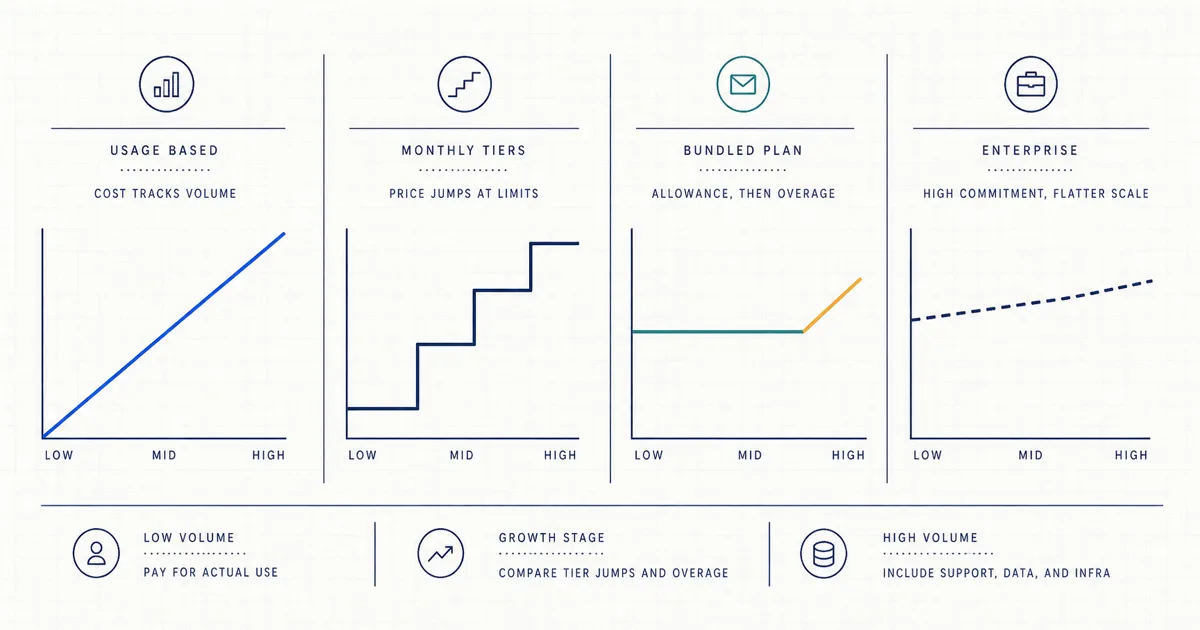
Low or volatile volume favors flexibility, while stable high volume makes committed tiers and negotiated rates easier to justify. Volume alone is not enough. Two teams sending 250,000 messages can have different answers if one has a steady daily flow and the other sends most mail in a two-hour event.
Scenario checks at 50K, 250K, 1M, and 5M messages
- 50,000 per month: compare a metered baseline with entry tiers. At this scale, unused allowance and feature requirements can matter more than a small difference in email API pricing.
- 250,000 per month: test a normal month and a campaign or incident peak. A bundle can work when overages are rare; repeated overage usually signals that a larger tier deserves evaluation.
- 1 million per month: request volume options while keeping a public metered baseline. Dedicated infrastructure, retention, and support can now move transactional email cost more than the base sending line.
- 5 million per month: compare at least one negotiated proposal with a transparent usage model. Review minimum commitments, burst capacity, IP strategy, incident response, and renewal terms.
For a transparent benchmark, applying the official Amazon SES outbound rate of $0.10 per 1,000 messages produces base sending estimates of $5 at 50K, $25 at 250K, $100 at 1M, and $500 at 5M messages. These are TrueSaaSCost calculations, not vendor quotes. They intentionally exclude free-tier benefits, attachment data, inbound mail, dedicated IPs, deliverability tooling, and other AWS services. The example shows why transactional email pricing must separate the base send calculation from the complete operating bill.
How should you calculate the real monthly cost?
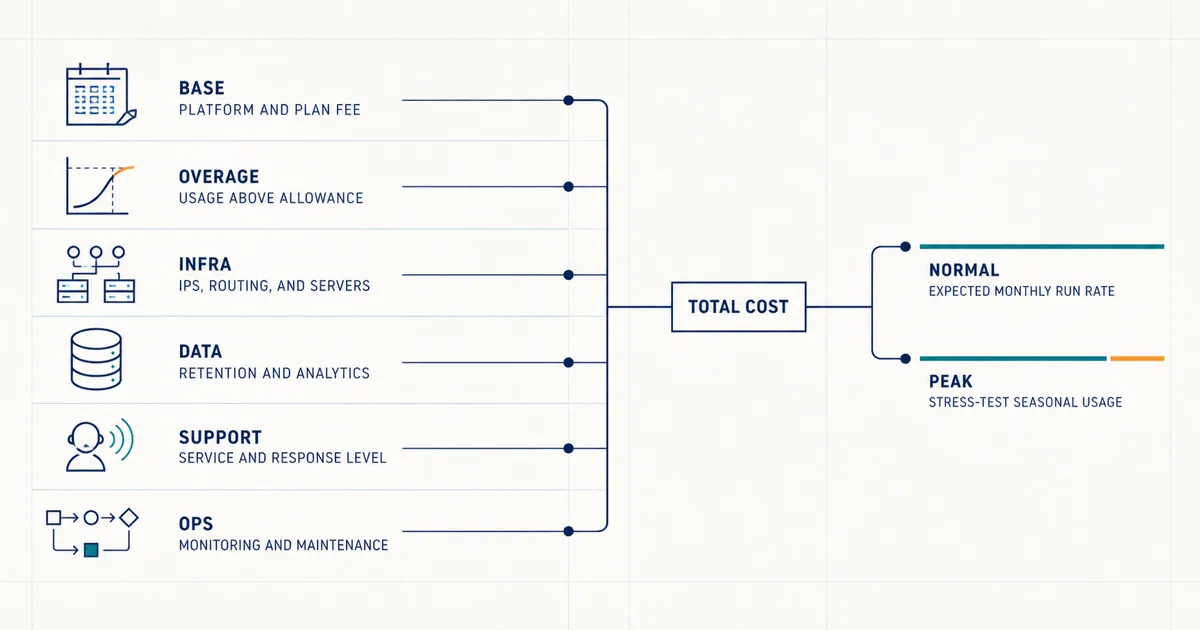
Add the base sending charge, overages, infrastructure, retention, validation, support, and operational labor for both normal and peak months. Use the same assumptions for every provider, record the source date, and keep uncertain items visible instead of hiding them inside a single estimate.
Monthly total cost = base plan or metered sends + overages + dedicated infrastructure + data and retention + validation + support + operating labor. This formula is the core of the original TrueSaaSCost framework. It makes email API pricing comparable even when one provider bundles features and another itemizes them.
- Define volume: record normal, peak, and twelve-month expected messages. Separate inbound processing if it has its own billing unit.
- Normalize the bill: calculate the effective cost per 1,000 messages after recurring fees and realistic overages, not only the advertised unit rate.
- Add required operations: include log retention, message retention, validation, IP options, security controls, and the support level the team actually needs.
- Test failure conditions: note daily limits, burst constraints, quota approval, contract minimums, and the cost of a peak that exceeds forecast.
- Recheck official sources: confirm the price, allowance, and feature scope immediately before procurement and save the verification date.
Postmark illustrates why feature scope belongs in the formula. Its official pricing page currently lists Basic at $15 per month for 10,000 messages with extra messages at $1.80 per 1,000, while higher plans change overage rates, retention, domains, and support. Review the Postmark pricing page. Mailgun similarly presents monthly allowances, different overage rates, retention periods, support, and enterprise services on its official pricing page. These examples support a structural conclusion: two transactional email pricing plans with the same included volume may deliver different operational value.
Which hidden costs change the decision?
Hidden does not mean deceptive; it means absent from the headline sending rate. The following items should appear as explicit rows in every transactional email cost model:
- Dedicated IP or managed reputation: include the recurring fee, volume charge, and warm-up effort where applicable.
- Data transfer and attachments: a message-count rate may not include every byte or related cloud service.
- Retention and observability: longer logs, message history, event exports, and analytics can sit behind a higher plan or add-on.
- Address validation and inbound processing: confirm whether they use separate units and whether suppressed sends are still billable.
- Support and incident response: price the response level needed for password resets, receipts, and security alerts, not the cheapest available tier.
- Engineering time: migration, webhooks, template changes, domain authentication, monitoring, and provider failover have real labor cost.
How to choose without confusing transactional and marketing email
Keep this decision scoped to event-triggered delivery. If the real requirement is contact management, newsletters, automation journeys, or campaign seats, use the email marketing pricing packages guide. For broader market navigation, visit the email marketing pricing hub.
When both workloads use one vendor, separate streams, domains or subdomains, permissions, suppression logic, and reporting where the platform permits. A promotional spike should not obscure the cost or reliability of critical messages. That separation also prevents a broad marketing plan from becoming a weak proxy for transactional email pricing during procurement.
Transactional email pricing selection checklist
- Normal, peak, and annual volume are documented in the same units.
- The included allowance, overage block, and unused-capacity treatment are clear.
- Dedicated IP, retention, validation, inbound mail, support, and data charges are included.
- Critical delivery and incident-response requirements are separated from optional features.
- Public rates and proposal terms have a dated official source.
- The normal-month and peak-month effective rates are both calculated.
- Contract minimums, renewal terms, and migration labor are visible.
Use the email marketing cost calculator as a worksheet starting point, then replace its inputs with message-based units and the formula above. The TrueSaaSCost guides hub provides adjacent SaaS pricing frameworks. A final choice should be based on verified current terms and workload evidence, not an assumed universal winner.
Frequently asked questions
How much does transactional email cost per 1,000 emails?
The cost varies by model and included features, so compare the effective rate after base fees, overages, add-ons, and support. A base send rate is only one component, and a low rate can coexist with separate infrastructure or operations charges.
Is pay-as-you-go cheaper than a monthly email API plan?
Pay-as-you-go can be cheaper for low or irregular volume, while a monthly plan can win when its allowance and included features are consistently used. Compare both models at normal and peak volume before choosing.
When should a team consider a dedicated IP?
Consider a dedicated IP when sending volume is stable enough to maintain reputation and the operational benefits justify its fee and warm-up work. The decision should follow a deliverability plan rather than a volume threshold copied from another sender.
Should marketing and transactional email share one provider?
They can share a provider, but teams should isolate streams, reputations, permissions, and reporting when a marketing campaign could affect critical mail. The safer architecture depends on business impact, platform controls, and operational ownership.
Source check: July 25, 2026. Provider prices and policies can change. Recheck each linked official page before making a purchasing decision.