The most expensive mistake a marketing manager, solo founder, or RevOps director can make in 2026 is blindly believing the “starting at” price displayed on a SaaS vendor’s landing page. When you look for a reliable email marketing software cost comparison on the internet, you are inevitably bombarded with generic “Top 10” lists that rank platforms like Mailchimp, HubSpot, and ActiveCampaign side-by-side without any strategic context. This approach is fundamentally flawed.
The stark reality is this: The absolute best platform for a solopreneur Creator can easily become a financial black hole for a B2B SaaS company requiring multiple team seats. Conversely, a platform deemed “expensive” on the surface might actually emerge as the most cost-effective solution for a high-volume Ecommerce brand when you calculate the true Total Cost of Ownership (TCO). In the SaaS industry, there is no universal “best” tool. There is only the most mathematically optimized fit for your specific Business Persona.
This exhaustive 2026 email marketing software cost comparison deconstructs the underlying pricing logic of the industry’s major platforms. We will reveal precisely why your business model—not your subscriber count—must dictate your software choice, helping you analyze the True SaaS Cost of your marketing stack without falling victim to hidden premium traps.
Table of Contents: Ultimate Cost Analysis
- 1. Why the Standard Email Marketing Software Cost Comparison is Flawed
- 2. Unveiling the Hidden Costs: Gating, Overages, and Seats
- 3. The Creator Persona: ActiveCampaign vs Kit Cost Analysis
- 4. The B2B SaaS Persona: Revenue Operations & The CRM Variable
- 5. The Ecommerce Persona: High Volume, ROI, and Opportunity Costs
- 6. How to Run an Instant Email Marketing Software Cost Comparison
- 7. Frequently Asked Questions (FAQ)
1. Why the Standard Email Marketing Software Cost Comparison is Flawed
Most online software comparisons fail aggressively because they treat digital marketing platforms as raw commodities. When running an email marketing software cost comparison, amateur reviewers assume that managing 10,000 contacts costs roughly the same across all providers, provided the basic feature lists look somewhat similar. This oversimplification leads to massive budget overruns, severe technical debt, and ultimately, platform migration headaches.
To understand the real financial impact on your bottom line, any valid email marketing software cost comparison must deeply dissect the hidden variables that standard PR comparisons intentionally ignore. It is not about how many emails you can send; it is about the structural economics of the software itself.
2. Unveiling the Hidden Costs: Gating, Overages, and Seats
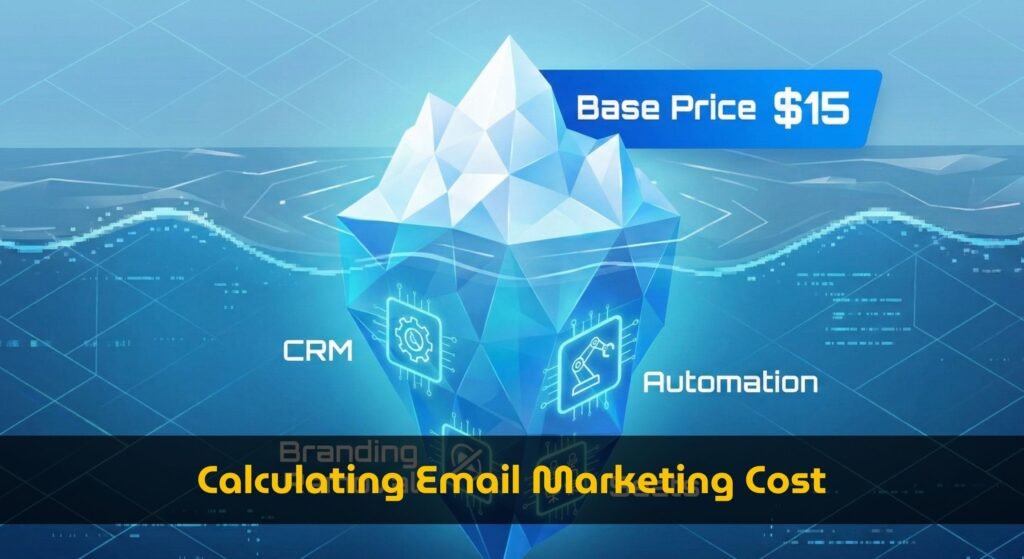
When you conduct a preliminary email marketing software cost comparison and look at a vendor’s pricing table, you are usually seeing the heavily subsidized cost of the “Standard” or “Essentials” plan. This plan is artificially designed for a single user with a very low contact count. However, as digital marketing experts, we can definitively tell you that the base subscription is rarely what shows up on your corporate credit card statement six months later.
A rigorous email marketing software cost comparison reveals that hidden costs typically fall into three predatory categories that are conveniently omitted from the headline price:
A. Feature Gating (The “Pro Tier” Trap)
Many marketing platforms gate absolutely essential workflow features behind their highest tiers. For example, if you need “Advanced Attribution Reporting” to track your return on investment properly, or “Conditional Split Logic” for complex sales funnels, you are often forced to jump from a $50/month starter plan to a $150/month professional plan. In a true email marketing software cost comparison, you quickly realize you aren’t paying for more contacts; you are paying a 200% premium just to access a single functional button. (We extensively documented this specific tactic in our Email Marketing Pricing Packages Warning Guide, which you should read before signing any contract.)
B. Hidden Overage Charges & CPM Spikes
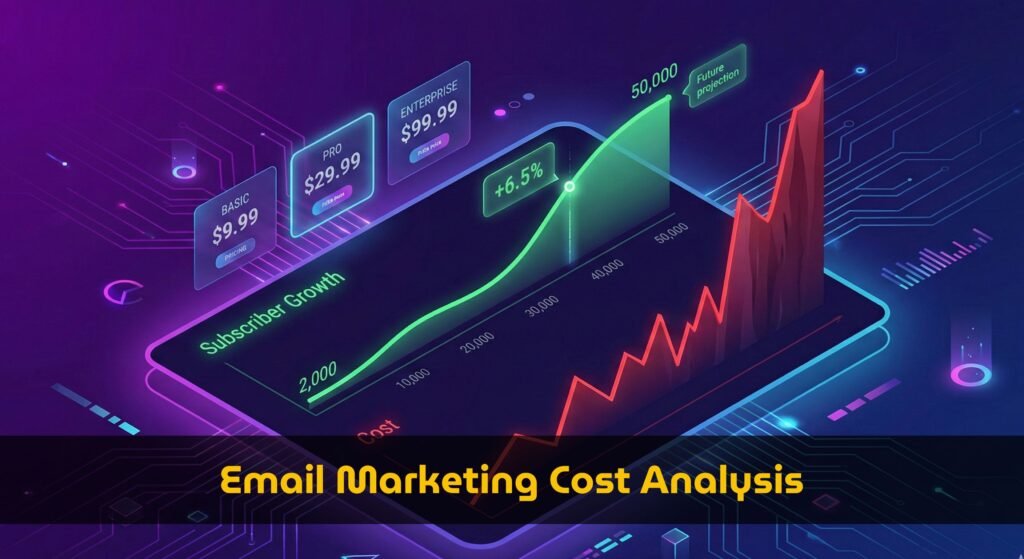
If you operate an Ecommerce business, your sending volume naturally fluctuates around holidays. Some platforms charge strictly by database size (contact count), while others heavily cap the actual number of emails you can send per month (e.g., a hard limit of 10x your contact limit). Crossing this invisible algorithmic line triggers massive overage fees. If your email marketing software cost comparison does not factor in seasonal overages, your Q4 budget will be obliterated.
C. The “Seat Trap”: How Team Size Distorts Value
This is the single most overlooked variable in any standard email marketing software cost comparison: Human Capital Access. For a solo Creator, the cost of “seats” (individual user licenses) is entirely irrelevant because they are the sole operator. However, for a B2B organization, the required seat count is a compounding financial multiplier.
• Tool A might charge a $100/month flat fee that includes unlimited users.
• Tool B might charge an $80/month base, but demands $40 for every additional seat.
On the surface of a bad email marketing software cost comparison, Tool B looks cheaper ($80 vs $100). But once you add the 4 extra seats ($160), Tool B becomes $240/month—a staggering 2.4x more expensive than Tool A.
3. The Creator Persona: ActiveCampaign vs Kit Cost Analysis
To execute an intelligent financial decision, you must stop searching for the generic “best tool” and start performing an email marketing software cost comparison based purely on your “best fit.” We have analyzed thousands of pricing data points to create three distinct analytical personas. Let us start with The Creator.
The Creator Profile
- Seats Needed: 1 (Solo or with 1 VA).
- Core Need: Deliverability, simple automations, landing pages, digital product sales.
- Unnecessary Bloat: Complex CRM pipelines, B2B lead scoring, multi-user permissions.
If you are a content creator, newsletter author, or online coach, your business model relies entirely on high engagement and content delivery. Your operational structure is lean. In this scenario, we often see creators gravitating towards “powerful” B2B tools like ActiveCampaign simply because of industry hype. However, when we run a precise email marketing software cost comparison between ActiveCampaign and Kit (formerly ConvertKit) for creators, the financial data shows a massive divergence.
Kit is algorithmically optimized for this specific persona. Its pricing model is strictly subscriber-based. You gain full access to visual automation features without paying a single cent for “Sales CRM” tools you will never deploy. Conversely, ActiveCampaign is engineered as a Customer Experience Automation (CXA) platform. A significant portion of its hefty price tag justifies its robust CRM and B2B sales pipeline features. If you are a Creator, buying ActiveCampaign means you are effectively paying a monthly “CRM Tax” for features that will sit idle indefinitely.
The Creator Verdict: In an accurate email marketing software cost comparison for a Creator with 10,000 subscribers, paying for Kit’s Creator Pro plan is mathematically more efficient than ActiveCampaign’s Professional plan. Every dollar spent goes toward features you actually utilize (like newsletter referral systems and creator networks), rather than subsidizing B2B sales pipelines.
4. The B2B SaaS Persona: Revenue Operations & The CRM Variable
The financial logic flips entirely when we adjust our email marketing software cost comparison to look at Business-to-Business (B2B) SaaS companies and enterprise agencies.
The B2B SaaS Profile
- Seats Needed: 5 to 20+ (Sales & Marketing alignment).
- Core Need: Deep integration with Sales CRM, predictive Lead Scoring, Advanced Attribution.
- Non-Negotiable: Detailed pipeline reporting to measure long sales cycles.
For a B2B company, an email marketing software cost comparison must never be viewed in isolation; it must be evaluated as part of a larger “Revenue Operations” (RevOps) stack. Here, choosing a conventionally “cheap” tool like the Mailchimp Standard Plan will result in catastrophic failure because it lacks the granular lead scoring and pipeline management required to close a 6-month enterprise sales cycle. If you choose the cheap route, you will instantly be forced to purchase a separate CRM (like Pipedrive) and pay for a premium middleware integration tool (like Zapier) just to connect the disconnected data silos.
| Infrastructure Choice | Software Components & Breakdown | Total Monthly Cost |
|---|---|---|
| Option A: Disconnected “Cheap” Stack | Basic Email Tool ($100) + Separate CRM ($75/user × 5 = $375) + Zapier Premium ($50) | $525 / month |
| Option B: The All-in-One CRM Platform | ActiveCampaign Plus Plan (Includes native CRM, Lead Scoring, and 5+ seats natively) | $350 / month |
As this email marketing software cost comparison explicitly demonstrates, for the B2B persona, the inherently “expensive” tool (ActiveCampaign or HubSpot) is actually the vastly cheaper and superior option because it cleanly consolidates your stack. It provides Advanced Reporting and Sales CRM natively. This proves why comparing the isolated “per subscriber” price is the most dangerous metric in B2B marketing procurement.
Stop Using Spreadsheets to Calculate SaaS Costs
Our dynamic logic engine factors in seat counts, CRM requirements, and overage limits instantly. Don’t guess your monthly burn rate.
5. The Ecommerce Persona: High Volume, ROI, and Opportunity Costs
Ecommerce is brutally focused on volume, velocity, and direct attribution. Unlike B2B (which might send one thought-leadership newsletter a week) or Creators (maybe two broadcasts), Ecommerce brands routinely send 8 to 12 promotional campaigns per month, plus incredibly heavy transactional automated flows (Abandoned Cart, Browse Abandonment, Post-Purchase Upsells).
The Ecommerce Profile
- Seats Needed: 2 to 4.
- Core Need: Tight integration with Shopify API, native SMS, dynamic product blocks.
- Risk Factor: Strict sending limits and astronomical overage fees.
When running an email marketing software cost comparison for an Ecommerce store, you must look intensely at the “CPM” (Cost Per Mille / Thousand emails sent) hidden deep within the platform’s terms of service. According to Shopify’s internal marketing data, hyper-segmented data is what drives revenue.
Some platforms, like Klaviyo or Omnisend, are engineered from the ground up specifically for Ecommerce. In a basic email marketing software cost comparison, they may appear significantly more expensive per subscriber than a generic tool like Constant Contact. However, their immense financial value lies purely in the depth of their data connection.
A generic tool might only see that a user “visited the website.” An Ecommerce-first tool sees the exact product variant viewed, the cart value, the historical purchase frequency, and the customer’s lifetime value (LTV). If your email marketing software cost comparison leads you to choose a cheaper, generic tool for Ecommerce, you will temporarily save $100 on the monthly subscription, but you will hemorrhage thousands of dollars in potential revenue because your automation lacks the data granularity to upsell dynamically. Furthermore, generic tools often hard-cap sending limits. For Ecommerce, a proper email marketing software cost comparison must include the “Opportunity Cost” of lost revenue derived from inferior automation.
6. How to Run an Instant Email Marketing Software Cost Comparison
The extensive analysis above proves one absolute truth: You cannot conduct an accurate email marketing software cost comparison using a napkin or a static Excel spreadsheet. There are far too many volatile variables—fluctuating seats, mandatory add-ons, send frequency multipliers, and hidden feature tiers.
Trying to manually perform an email marketing software cost comparison between HubSpot, ActiveCampaign, Kit, and Mailchimp across three different subscriber tiers and two different team sizes would take a skilled financial analyst hours of tedious research.
This exact friction is why we built the True SaaS Cost logic engine. Our tool is not just a static price list; it is a living algorithm. It instantly executes a perfect email marketing software cost comparison by accounting for:
- Real-Time Feature Parity: It knows that if you select “Sales CRM,” it must compare ActiveCampaign’s Plus plan against Mailchimp’s Premium plan (or automatically add the cost of a standalone CRM).
- The Seat Multiplier: It calculates exact per-user licenses.
- One-Click Persona Optimization: Whether you are a Creator, B2B, or Ecommerce, the calculator instantly adjusts the requirements and re-ranks the most cost-effective platforms in seconds.
7. Frequently Asked Questions (FAQ)
Why is a B2B email marketing software cost comparison so different from a Creator comparison?
How do “seats” affect my email marketing software cost comparison?
Should Ecommerce brands use generic platforms to save money?
Stop Guessing Your Software Budget
Are you overpaying for a CRM you don’t use? Or are you about to buy a “cheap” tool that will cost you double in seat add-ons? Generate your custom report instantly.
Run Your Custom Cost Comparison